The Go Blog
Better HTTP/1 connection reuse
Take a look at the following function:
func getStatus(url string) (int, error) {
    resp, err := http.Get(url)
    if err != nil {
        return 0, err
    }
    defer resp.Body.Close()
    return resp.StatusCode, nil
}
It sends a GET request to url and returns the HTTP status code.
Using HTTP/1 (GODEBUG=http2client=0), calling this function 100 times against
index.golang.org takes ~710 milliseconds on Go 1.26
on my machine. On Go 1.27, the same program takes ~150 milliseconds.
That is almost 5 times faster! How is such a drastic performance difference possible?
The cost of establishing HTTP connections
To understand the difference, consider what happens on the network when we make an HTTP request.
Go’s net/http package supports HTTP/1.0, HTTP/1.1, and
HTTP/2. All three run over TCP, and usually over TLS when talking to HTTPS
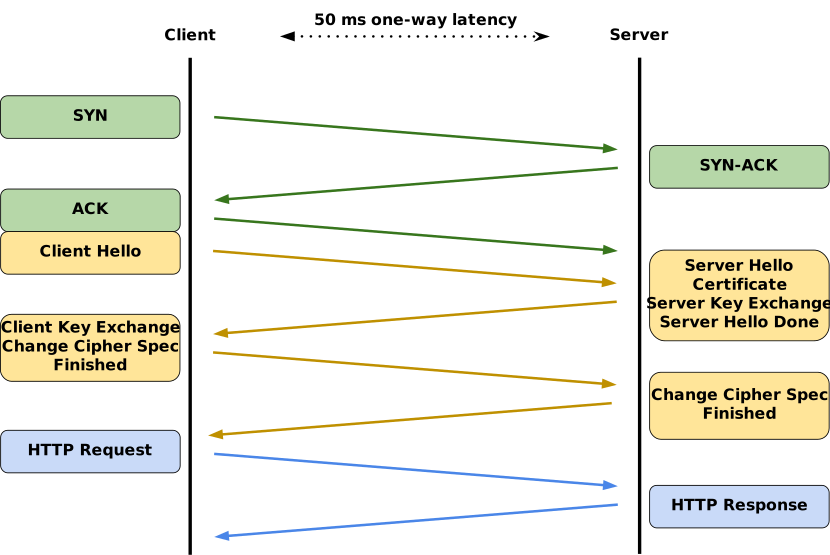
endpoints. Making a request over a new connection looks something like this:
- TCP handshake (1 RTT): the client sends a
SYNpacket, the server replies withSYN-ACK, and the client replies withACK. Because the client can send the first TLS message alongside that finalACK, establishing the TCP connection takes 1 round-trip time (RTT). - TLS handshake (2 RTT): next, a TLS handshake exchanges encryption keys and verifies the server’s identity; using TLS 1.2, this takes 2 RTT.
- HTTP request: with the keys exchanged, HTTP requests can finally be sent after a total of 3 RTT.
These round trips (plus some CPU time spent on TLS handshakes) add up quickly. In cross-region communications, one-way latencies often reach or exceed the 50 ms (100 ms RTT) shown in the diagram above. Compared to the 300 ms spent just setting up the connection, the HTTP request itself can be cheap to serve, taking only a little over 1 RTT when bandwidth is plentiful or the HTTP response is small.
Even in more favorable conditions, opening a new connection can still be expensive. Our opening benchmark queries index.golang.org, which is distributed worldwide and supports TLS 1.3. This means that latency is relatively low, and the TLS handshake can actually finish in just 1 RTT. Even so, the performance difference is still very noticeable.
Connection reuse
To avoid paying this setup cost on every request, HTTP clients and servers try to reuse existing connections across multiple requests when possible. The mechanics of this differ based on the HTTP version:
- HTTP/1.0: while not part of the official specification, clients and
servers often opt into connection reuse by sending a
Connection: keep-aliveheader. Reuse continues until either endpoint omits the header or sends aConnection: closeheader. - HTTP/1.1: connections are persistent by default, and can be reused for
subsequent requests and responses unless either side declares otherwise by
sending a
Connection: closeheader. - HTTP/2: multiple requests and responses can be multiplexed over a single TCP connection.
When connection reuse fails
In HTTP/1 (both HTTP/1.0 and HTTP/1.1), multiple requests and responses on the
same connection are sent sequentially on the wire. If two GET requests are
sent to index.golang.org over the same TCP
connection, the responses arrive as a single stream of bytes:
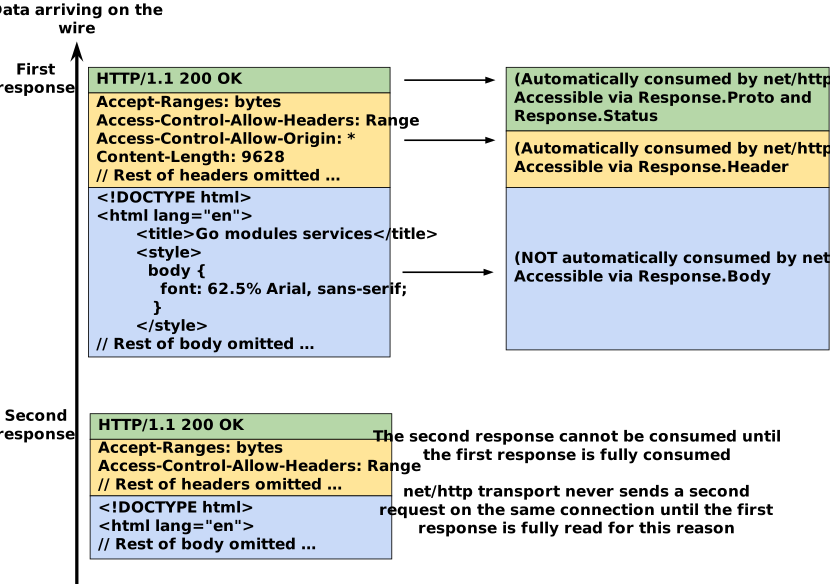
As shown in the diagram, net/http.Get reads and parses
the status line and headers from the byte stream to populate
net/http.Response, then returns immediately. The
response body remains unread on the connection and is consumed only as the
caller reads from net/http.Response.Body.
Because responses are sent back-to-back on the same stream,
net/http can only find the start of the next response after
the current response body has been read to the very end (as determined by the
Content-Length or Transfer-Encoding header).
Now look back at our example program, where we never read resp.Body:
func getStatus(url string) (int, error) {
    resp, err := http.Get(url)
    if err != nil {
        return 0, err
    }
    defer resp.Body.Close()
    return resp.StatusCode, nil
}
Through Go 1.26, when resp.Body.Close is called, net/http
sees that there is still an unread response body. Realizing that it cannot reuse
the connection, it abandons the existing connection and creates new connections
for its next requests, causing it to repeatedly incur the cost of establishing
new connections.
(HTTP/2 does not have this problem. Because it multiplexes streams of frames over a single connection rather than sending responses strictly back-to-back, an unread response body on one stream does not block other requests from sharing the connection.)
Where failed connection reuse hurts
This subtlety of HTTP/1 connection reuse can cause silent performance degradation in seemingly innocuous code.
As in our opening example, a client might only care about an API response’s
status code. However, the API endpoint it is talking to might send bodies that
provide more detailed but ultimately unused information, such as {"success": true, "message": "update processed"}. This will unfortunately cause connection
reuse to fail.
Even programs that do read the response body can run into this issue if they
stop just short of the end of the body. For example,
encoding/json.Decoder stops reading as soon as
it sees the closing } of a JSON object. If a server sends a JSON response
terminated with a newline, decoding the JSON object will leave the newline still
unread. The connection cannot be reused for a new request until that newline is
consumed. Thus, a healthy connection might end up being abandoned, even though
it was only a single byte away from being reusable.
The manual solution
The unread body problem has been a long-standing sharp edge. Over the years, many Go developers came up with their own workarounds. Most commonly, this is done by draining the response body prior to closing it:
func getStatus(url string) (int, error) {
    resp, err := http.Get(url)
    if err != nil {
        return 0, err
    }
    drainAndCloseBody(resp.Body)
    return resp.StatusCode, nil
}

func drainAndCloseBody(body io.ReadCloser) {
    io.Copy(io.Discard, body) // Drain the response body before closing it.
    body.Close()
}
While this works for small responses, if the unread body is large, establishing a new TCP connection can be faster than downloading and discarding the rest of the body. A better approach is to cap the number of bytes we are willing to drain:
func drainAndCloseBody(body io.ReadCloser) {
    io.CopyN(io.Discard, body, 256<<10) // Only drain up to 256 KB.
    body.Close()
}
However, a server might send a response body that trickles in slowly, so we also need to cap the time we spend draining:
func drainAndCloseBody(body io.ReadCloser) {
    drainDone := make(chan struct{}, 1)
    go func() {
        io.CopyN(io.Discard, body, 256<<10) // Only drain up to 256 KB.
        drainDone <- struct{}{}
    }()
    // Only spend at most 50 ms trying to drain the response body.
    select {
    case <-drainDone:
    case <-time.After(50 * time.Millisecond):
        // If we reach the 50 ms timeout, body.Close will run and interrupt the
        // io.CopyN, preventing goroutine leaks.
    }
    body.Close()
}
Of course, we also do not want to block for up to 50 milliseconds when closing a response body. Instead, we can drain the body asynchronously in the background and let it race against subsequent requests:
func drainAndCloseBody(body io.ReadCloser) {
    drainDone := make(chan struct{}, 1)
    go func() {
        io.CopyN(io.Discard, body, 256<<10) // Only drain up to 256 KB.
        drainDone <- struct{}{}
    }()
    go func() {
        // Only spend at most 50 ms trying to drain the response body.
        select {
        case <-drainDone:
            // If the drain can finish before a new request is sent, the
            // connection will be reused; otherwise, a new connection is
            // created, and the current connection will be put in a pool of
            // idle connections, potentially being reused for another future
            // request.
        case <-time.After(50 * time.Millisecond):
            // If we reach the 50 ms timeout, body.Close will run and interrupt
            // the io.CopyN, preventing goroutine leaks.
        }
        body.Close()
    }()
}
As we can see, draining response bodies safely is surprisingly tricky and cumbersome. Worse, as the practice of draining response bodies spread, some nuances were often lost. This has led to misunderstandings such as attempting to drain response bodies for HTTP/2 connections, when doing so is unnecessary.
The current state and conclusion
Starting in Go 1.27, net/http.Transport
automatically does everything we have implemented in the code above: it will
asynchronously drain an unread HTTP/1 response body for up to 50 ms or 256 KB.
It also implements additional optimizations; for example, when a response
contains the Connection: close header, draining the body is guaranteed to be
wasted work, and it therefore skips doing so. Note that this behavior might
evolve in future versions of Go, as other possible enhancements become apparent.
As a general best practice, we now recommend that users simply close their HTTP bodies once they no longer need them, like in our original example:
func getStatus(url string) (int, error) {
    resp, err := http.Get(url)
    if err != nil {
        return 0, err
    }
    defer resp.Body.Close()
    return resp.StatusCode, nil
}
Go is all about simplicity. Let your code stay clean and simple, and let
net/http deal with the complexities on your behalf.
Previous article: Arch-specific SIMD in Go
Blog Index